
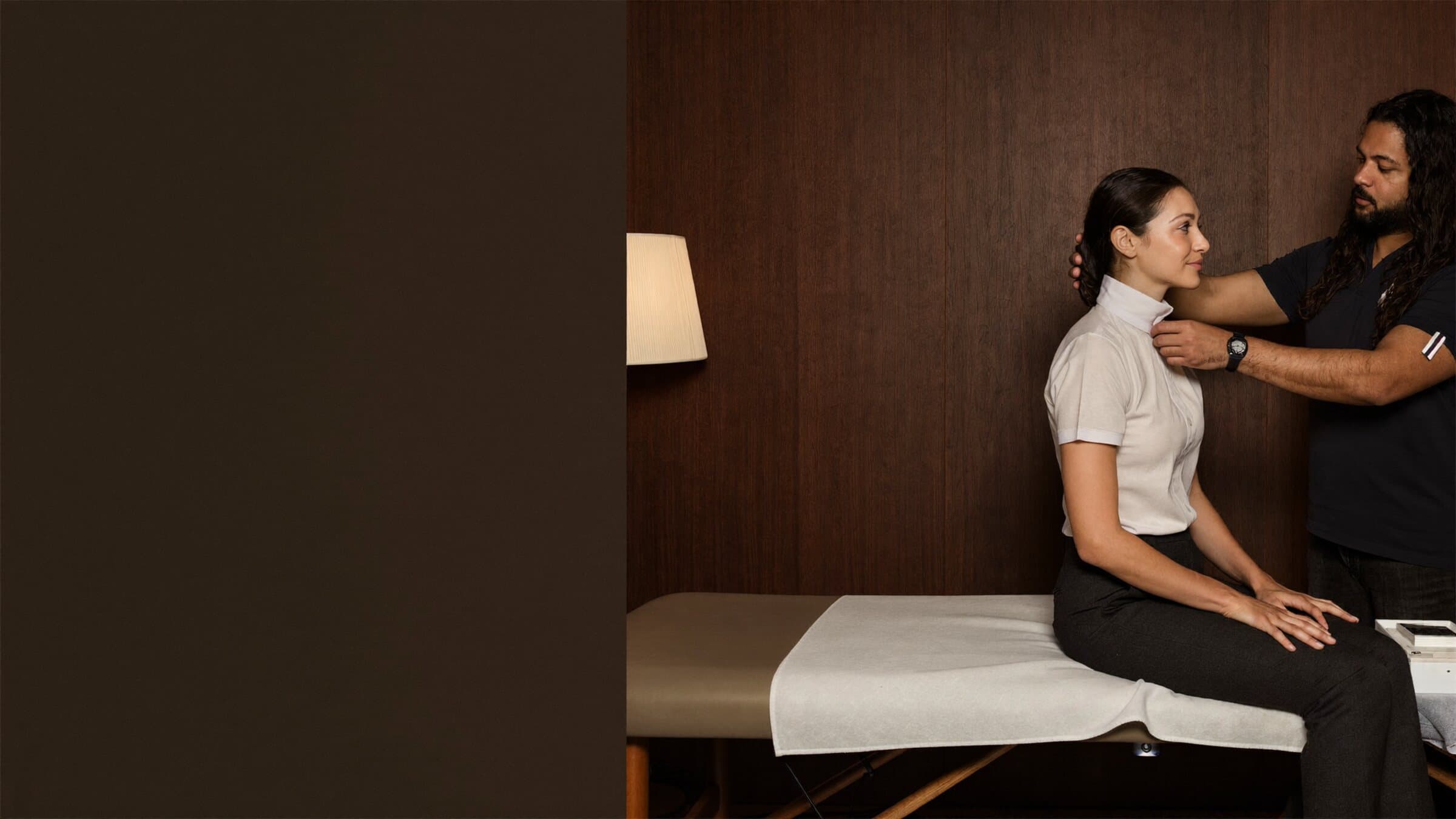
Workplace Posture Reset Programs
5 sections6 min read
The short answer
A workplace posture reset can be explored as a voluntary, desk-focused wellness and education concept, subject to clinical and operational approval. Employers should describe the workforce, setting, schedule, privacy, accessibility, and desired format. Content may address comfort, movement awareness, or general mobility, but it must not promise treatment, corrected posture, greater productivity, or a fixed employee outcome.
The program decision this page supports
Desk work can leave people wanting a brief change of position, guided movement, or a focused wellness experience during the day. A proposed posture reset should meet that need without treating posture as a diagnosis or implying that one ideal position suits everyone. Recovery Mode's concept may combine reviewed education with an approved hands-on element, but the final format, services, session timing, and staffing remain on hold until clinical and operational review. Employers should plan for voluntary participation, accessible alternatives, private questions, clear consent, and schedule design that does not expose health information to managers. The program should complement ordinary workplace ergonomics and medical care, not replace an ergonomic assessment, physical therapy, or evaluation of persistent or concerning symptoms.

Planning inputs that change the scope
Desk-work use case
Use the program for a defined desk-work audience rather than labeling every employee as having a posture problem. Describe how long people typically work at screens, whether roles rotate between sitting and standing, and which shifts or teams would be invited. Ask employees what format feels useful instead of assuming a universal need. Participation should be optional and accessible to people who cannot or do not want to perform a movement. Persistent pain, numbness, weakness, or other concerning symptoms belong in an appropriate clinical pathway.
Targeted massage concept
A targeted massage concept can be considered only if the setting, practitioner scope, consent process, privacy, hygiene, and current service availability are approved. Employers should not advertise a body area, technique, session length, or expected result in advance. Employees need a clear description of contact, clothing expectations, and their right to stop or decline. Managers should not receive individual health responses. Any hands-on element remains a wellness service and should not be represented as diagnosis, injury treatment, or correction of a worker's posture.
Mobility education
Mobility education can focus on practical variation: changing positions, noticing comfort, taking reasonable movement breaks, and choosing simple actions that fit the work setting. A useful workplace session avoids rigid rules, fear-based messages, and claims that a single exercise prevents pain. Provide the presenter with the audience, workspace constraints, available room, accessibility needs, and employer policies. If demonstrations are included, offer seated and standing choices where appropriate and make observation an acceptable form of participation. Individual medical advice stays outside a general workplace session.
Session scheduling
Build the schedule from shift coverage, employee availability, registration method, room access, screening, changeover, and the approved format. Do not assume a standard employee session length or daily capacity. Decide whether participation will be prebooked, offered in groups, or managed another way after operational review. Protect private appointment information and avoid sending health-related notes to managers. Include setup and breakdown time, accessible arrival, cleaning, and a buffer for employee questions. Publish the schedule only after staffing and format are confirmed.
No treatment or productivity promise
Set honest expectations in every invitation. A posture reset does not guarantee pain relief, improved posture, fewer injuries, better productivity, reduced absence, or any other health or business result. Employees should know the program is voluntary, general in nature, and not emergency or diagnostic care. The employer should maintain its own ergonomic, occupational health, and accommodation processes. Recovery Mode and the employer must approve participant language, screening, consent, privacy, incident escalation, and outcome measurement before the program is offered.


Build a responsible program
- 1
For Workplace Posture Reset Programs, define the audience, event setting, expected participation, venue limits, and organizer objective.
- 2
Choose only services that can be delivered safely and lawfully in that setting by appropriately credentialed people.
- 3
Design voluntary consent, privacy, accessibility, sanitation, power, water, and queue procedures before promoting the activation.
- 4
Set a run of show with staffing, arrival, setup, participant flow, stop criteria, and a weather or venue contingency.
- 5
Approve the final scope, claims, insurance requirements, data handling, and escalation contacts in writing.
Safety, consent, privacy, and escalation
A recovery studio is not emergency or diagnostic care. New, severe, worsening, or unexplained symptoms should be assessed by an appropriate health professional before a wellness booking. A website cannot diagnose a condition, clear someone for a service, or replace emergency or clinical care. New, severe, worsening, or unexplained symptoms, fainting, breathing difficulty, chest symptoms, major swelling, loss of function, or other urgent concerns should be routed to appropriate medical care instead of a recovery booking. For Workplace Posture Reset Programs, follow the current service-specific screening and stop guidance rather than relying on general information alone.
Move from planning to an inquiry
Return to Corporate Wellness in New York City for the complete topic map.
For Workplace Posture Reset Programs, the right choice can change with the day. Compare the current experience, level of guidance, time, preparation, and what you intend to do next. Use the live booking or contact source for changing details, and do not treat general information as personal medical clearance.
Frequently asked questions
The concept is intended for a defined workplace audience seeking a brief, voluntary wellness or movement experience related to desk work. Employers should describe roles, shifts, workspace conditions, and accessibility needs. It is not a diagnosis, ergonomic assessment, medical treatment, or mandatory employee activity.
A reviewed program may include general education, movement options, and an approved hands-on concept. The final components depend on clinical scope, workplace conditions, staffing, consent, privacy, and current availability. Do not advertise massage, techniques, body areas, or other specific elements before written approval.
No standard employee session length should be assumed. Timing depends on the approved format, screening, consent, transition needs, workforce schedule, room access, and staffing. Give Recovery Mode your shift windows and participation estimate so a workable schedule can be evaluated and confirmed in writing.
Mobility education can be considered when the topic, presenter, audience, space, and accessibility options are reviewed. Content may encourage position changes and general movement awareness without diagnosing employees or prescribing individual care. Observation and alternative movements should remain acceptable participation choices.
The program does not guarantee corrected posture, pain relief, injury prevention, productivity, attendance, or employee satisfaction. It also does not replace ergonomics, occupational health, physical therapy, or medical evaluation. Participant communications and any measurement plan should state those boundaries clearly.
Next step
For Workplace Posture Reset Programs, confirm the current service details, responsible provider, screening, and personal-fit questions before reserving. Use Contact Recovery Mode for an operational question, and use an appropriate health professional for medical clearance or symptoms that need evaluation.
Start an inquiry
Planning for a team, an event, or a workplace starts with a conversation about scope and logistics.
Sources and review basis
- Corporate Wellness(opens in a new tab)
First Party Web. Supports: The official site markets corporate wellness services. Limits: Capacity, staffing, service area, COI, logistics, and client proof are not published in sufficient detail.
- Massage Evidence And Safety(opens in a new tab)
Official Health Source. Supports: Massage evidence and safety language should remain qualified and avoid guaranteed outcomes. Limits: Does not substantiate a Recovery Mode outcome claim.
- Health Claims(opens in a new tab)
Official Regulator. Supports: FTC health-marketing guidance requires truthful, non-misleading, adequately substantiated express and implied health claims. Limits: Service-specific evidence and qualified review remain necessary.
- Physical Activity Guidelines for Americans(opens in a new tab)
U.S. Department of Health and Human Services. Supports: Evidence-based physical activity guidance and the role of gradual, appropriate activity.
- Adult Activity: An Overview(opens in a new tab)
Centers for Disease Control and Prevention. Supports: Current adult physical-activity guidance and the principle that activity can be accumulated across a week.