
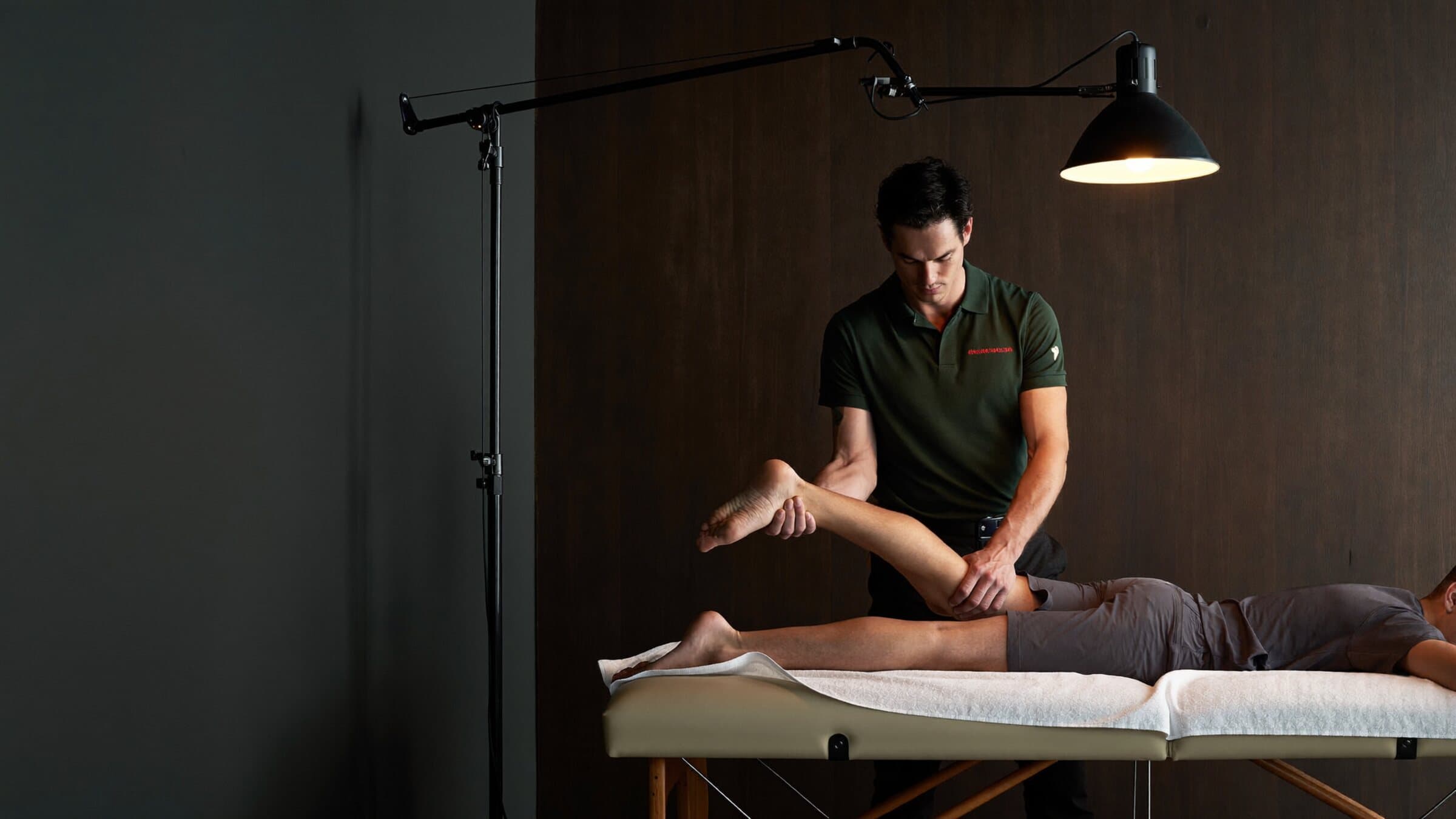
What the Evidence Says About Sports Massage
5 sections7 min read
The short answer
Massage research has examined pain, soreness, function, range of motion, relaxation, and other outcomes, but findings vary by condition, technique, timing, and study quality. Some people report short-term comfort or reduced perceived soreness. Massage does not guarantee better performance, injury prevention, or tissue healing, and temporary tenderness or rare adverse effects can occur.
The decision this page helps you make
When you evaluate massage evidence, distinguish what researchers measured from what a studio promises. A study involving a specific population and technique cannot automatically support every sports massage claim. Reviews can suggest short-term effects for some symptoms or settings while still finding uncertainty, inconsistent methods, and limited information about long-term outcomes. Personal response also varies. It is reasonable to explain that a client may experience relaxation, changed comfort, or a different sense of movement. It is not reasonable to turn that possibility into guaranteed recovery, faster healing, detoxification, injury prevention, or improved competition results. Safety, practitioner competence, active consent, and appropriate medical referral remain part of the evidence conversation.
What matters before you choose
Evidence for perceived soreness
Massage studies have examined perceived soreness, pain in specific conditions, range of motion, function, anxiety, and relaxation, among other outcomes. Those categories are not interchangeable. An improvement in a self-reported soreness scale does not prove faster tissue repair, and a short-term range change does not establish lasting performance improvement. Read the population, intervention, comparison, measurement, and follow-up before translating a result. Your previous response is useful planning context, but it does not guarantee the same response at the next appointment.
Mobility and relaxation context
Evidence for perceived soreness can support cautious wording such as may help some people feel less sore in a defined context. It does not support guaranteed relief or one exact effect for every client. Study techniques, timing, pressure, exercise type, and outcome windows differ. Recovery Mode should connect any claim to the actual service and cite the source rather than relying on a broad massage-is-proven statement.
Performance uncertainty
Mobility and relaxation are experiences that can be described without overstating mechanism. A person may feel easier movement or calmer after a session, but those reports do not diagnose restricted fascia, correct posture permanently, or show that an injury healed. Where research is mixed or indirect, say so. The level of evidence should limit how confidently you interpret any benefit statement. A licensed therapist can adapt hands-on work but cannot use the session to diagnose a condition or promise a cure.
Adverse effects
Performance claims are especially easy to overstate. Feeling better does not guarantee faster running, greater strength, reduced injury, or improved competition outcome. If a study does not measure performance, it cannot support a performance promise. Even when it does, a small group, narrow protocol, or uncertain result may not generalize. Use massage as an optional, preference-sensitive recovery experience rather than a competitive guarantee. The therapist should explain material risks and alternatives before any add-on that changes sensation or may leave visible marks.
Individual response
Massage is generally considered low risk when performed appropriately, but adverse effects can include temporary soreness, bruising, skin irritation, or symptom aggravation, with serious events reported rarely. Risk changes with health history, medication, pressure, technique, and provider competence. Confirm New York licensure, disclose relevant factors, maintain consent, and seek clinical evaluation for severe, persistent, worsening, neurologic, or unexpected symptoms. Consent applies to each area and technique, so you can modify positioning, pressure, draping, or the session itself.
A practical way to use this information
- 1
For What the Evidence Says About Sports Massage, start with the plain-language definition and separate the topic from adjacent terms that are often used interchangeably.
- 2
Apply the idea to the activity that came before and the demand that comes next instead of copying a universal protocol.
- 3
Use the evidence section to distinguish supported findings, mixed findings, practical experience, and unanswered questions.
- 4
If a service is relevant, review its preparation, supervision, stop process, and current operating details before booking.
- 5
Use a qualified professional for diagnosis, medical clearance, persistent symptoms, medication questions, or a concern outside a wellness studio's scope.
Fit, limits, and when to choose another path
Massage should not be used to delay medical evaluation. NCCIH advises people to discuss suitability with a health professional when they have relevant health conditions and to ask about the practitioner's training and credentials. A website cannot diagnose a condition, clear someone for a service, or replace emergency or clinical care. New, severe, worsening, or unexplained symptoms, fainting, breathing difficulty, chest symptoms, major swelling, loss of function, or other urgent concerns should be routed to appropriate medical care instead of a recovery booking. For What the Evidence Says About Sports Massage, follow the current service-specific screening and stop guidance rather than relying on general information alone.
Where this fits in the Recovery Mode system
Return to Evidence and Editorial Standards for the complete topic map.
Continue with What the Evidence Says About Infrared Sauna, What the Evidence Says About Cold-Water Immersion, or What the Evidence Says About Compression Boots when that decision is closer to your situation.
For the service or selection path, review Sports Massage in Astoria, Queens.
For What the Evidence Says About Sports Massage, the right choice can change with the day. Compare the current experience, level of guidance, time, preparation, and what you intend to do next. Use the live booking or contact source for changing details, and do not treat general information as personal medical clearance.
Frequently asked questions
Researchers have studied perceived soreness, pain in specific conditions, function, range of motion, relaxation, anxiety, and performance-related measures. Results depend on population, technique, timing, comparison, outcome definition, and study quality. Recent trauma, significant swelling, altered sensation, skin injury, or worsening pain changes whether massage is an appropriate next step.
Some evidence supports cautious short-term statements about perceived soreness in certain contexts, but protocols and findings vary. It does not prove faster tissue healing or guaranteed relief for every workout and person. A technique should earn its place through the agreed goal and active consent, not because it appears on a service list.
No. Massage cannot guarantee faster running, greater strength, injury prevention, or better competition results. A comfort change may be valuable to an individual while remaining separate from an objective performance claim. New loss of function, neurologic symptoms, or major swelling requires a clinical decision before routine hands-on work.
Temporary tenderness, bruising, skin irritation, or symptom aggravation can occur. Serious adverse events are uncommon but possible. Health history, medications, pressure, technique, and practitioner competence all influence risk. Technique names vary between practitioners, making a plain description of pressure, pace, placement, and expected sensation more useful.
Use your response as personal information about comfort and timing, not proof of mechanism or universal effectiveness. Track whether the experience helps your own decision while escalating persistent or concerning symptoms appropriately. Skin, medication, circulation, pregnancy, surgery, and injury context can all change how hands-on pressure should be approached.
Next step
For What the Evidence Says About Sports Massage, confirm the current service details, responsible provider, screening, and personal-fit questions before reserving. Use Book Your Recovery Session for an operational question, and use an appropriate health professional for medical clearance or symptoms that need evaluation.
Reserve a session
Current durations, prices, providers, and availability live in the booking system, not on this page.
Booking is handled by Acuity Scheduling. Nothing on this page is medical advice or clearance to participate.
Sources and review basis
- Massage Evidence And Safety(opens in a new tab)
Official Health Source. Supports: Massage evidence and safety language should remain qualified and avoid guaranteed outcomes. Limits: Does not substantiate a Recovery Mode outcome claim.
- Health Claims(opens in a new tab)
Official Regulator. Supports: FTC health-marketing guidance requires truthful, non-misleading, adequately substantiated express and implied health claims. Limits: Service-specific evidence and qualified review remain necessary.
- Recovery Mode sports massage page(opens in a new tab)
Recovery Mode. Supports: Sports massage formats, techniques represented, durations, and prices shown on the current page.
- Massage Therapy: What You Need To Know(opens in a new tab)
National Center for Complementary and Integrative Health. Supports: Evidence limits, safety considerations, and questions to ask a massage practitioner.
- New York massage therapy license requirements(opens in a new tab)
New York State Education Department. Supports: Massage therapy is a licensed profession in New York and the published licensure requirements.
- Physical Activity Guidelines for Americans(opens in a new tab)
U.S. Department of Health and Human Services. Supports: Evidence-based physical activity guidance and the role of gradual, appropriate activity.
- Adult Activity: An Overview(opens in a new tab)
Centers for Disease Control and Prevention. Supports: Current adult physical-activity guidance and the principle that activity can be accumulated across a week.
- Heat and Cold Therapy for Delayed Onset Muscle Soreness(opens in a new tab)
PubMed. Supports: A review found short-term soreness effects for some heat and cold approaches, with a need for more high-quality comparative evidence.
- Massage and Delayed Onset Muscle Soreness(opens in a new tab)
PubMed. Supports: A systematic review reported lower post-exercise soreness ratings in massage groups while not establishing a universal individual outcome.