
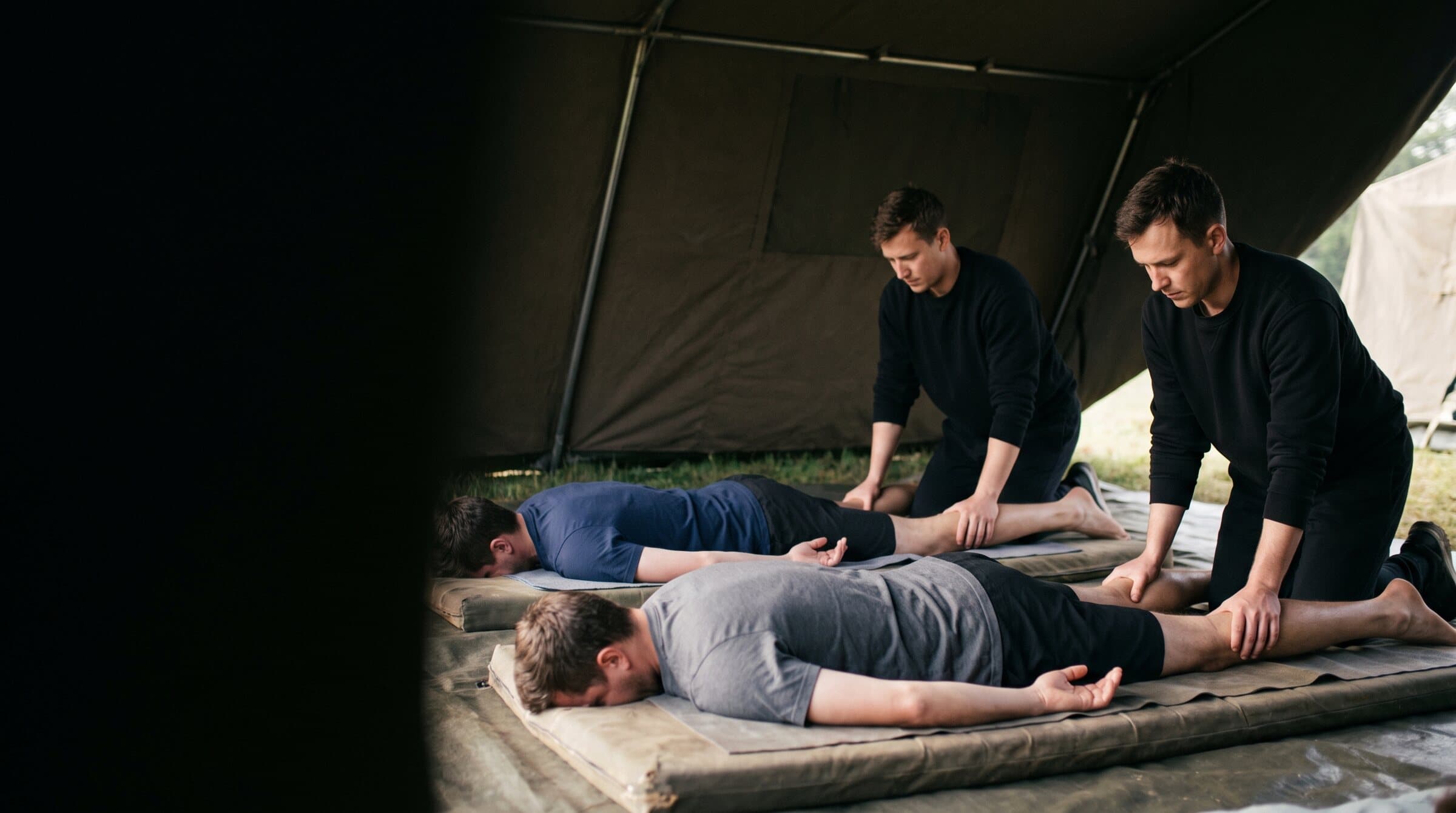
Recovery for Races and Endurance Events
5 sections6 min read
The short answer
Race and endurance organizers can request a reviewed recovery-zone concept for an expo, athlete area, or finish setting. Planning requires the race format, distances, registration, wave schedule, finish forecast, venue map, weather plan, accessible flow, medical coverage, and operating window. Station mix, footprint, staffing, participant throughput, and services are confirmed only after written review.
The program decision this page supports
Race recovery planning starts with the finish pattern, not the registration total. A road race, trail event, relay, cycling event, or multisport format can send participants into a recovery area at very different rates and in very different conditions. Recovery Mode can evaluate an organizer's proposed expo or finish-area experience, but no standard capacity or portable menu should be assumed. Provide the event schedule, distances, course and venue maps, participant profile, peak finish forecast, medical plan, weather contingencies, and space available. The final design must protect emergency access, support voluntary participation, offer clear screening and consent, account for mobility and sensory needs, and keep general recovery services distinct from medical assessment.

Planning inputs that change the scope
Race format and distance
Define the endurance event precisely. Share the sport, distances, terrain, relay structure, participant age range, registration categories, start format, cutoff times, and whether the request concerns an expo, pre-event area, finish zone, or hospitality space. Include environmental conditions the organizer is planning for, such as heat, cold, rain, or limited shelter. Recovery Mode can assess the concept only after understanding the format. An event category alone does not establish appropriate services, equipment, staffing, or operating hours.
Finish-area flow
Place the proposed recovery area on a scaled venue map. Show the finish chute, medical tent, hydration and food, baggage, restrooms, exits, emergency lane, accessible route, and expected spectator movement. Recovery queues must not block medical access or the natural movement of fatigued finishers. Provide setup and breakdown windows, loading restrictions, ground surface, shelter, utilities, storage, waste handling, and security. The organizer should identify who controls the site and who can change the layout if crowding or weather creates a hazard.
Participant throughput
Estimate throughput from finish data, not a blanket percentage. Share total registration, wave sizes, predicted finish distribution, peak fifteen-minute or hourly arrivals if available, and the expected share eligible to enter the area. Explain whether access is open, prebooked, credentialed, or time-limited. Recovery Mode can then model a queue only after the station, screening, changeover, and staffing assumptions are approved. Publish neither a capacity nor a wait-time promise until the operating plan has been tested and accepted.
Recovery-station mix
Ask for a recovery-station mix by describing participant needs, available space, climate, and desired experience. Specific hands-on, equipment-based, temperature-based, or educational elements must be reviewed for portability, professional scope, contraindications, cleaning, power, privacy, accessibility, and flow. A practical plan may use fewer stations than an early concept. Participants should understand that services are optional, do not diagnose injury, and do not guarantee faster recovery. Current availability must be confirmed in the final written scope.
Medical and emergency boundary
Keep the medical and emergency boundary unmistakable. The organizer retains a medical plan with qualified personnel, communications, transport access, and severe-weather procedures. Recovery staff need a clear process for stopping an interaction and referring a participant who appears ill, injured, confused, faint, or otherwise unsafe. The plan should cover incident reporting, lost-person procedures, minors, consent, privacy, and handoff points. Signage and staff briefing must direct urgent needs to medical care rather than allowing a recovery queue to become informal triage.

Build a responsible program
- 1
For Recovery for Races and Endurance Events, define the audience, event setting, expected participation, venue limits, and organizer objective.
- 2
Choose only services that can be delivered safely and lawfully in that setting by appropriately credentialed people.
- 3
Design voluntary consent, privacy, accessibility, sanitation, power, water, and queue procedures before promoting the activation.
- 4
Set a run of show with staffing, arrival, setup, participant flow, stop criteria, and a weather or venue contingency.
- 5
Approve the final scope, claims, insurance requirements, data handling, and escalation contacts in writing.
Safety, consent, privacy, and escalation
A recovery studio is not emergency or diagnostic care. New, severe, worsening, or unexplained symptoms should be assessed by an appropriate health professional before a wellness booking. A website cannot diagnose a condition, clear someone for a service, or replace emergency or clinical care. New, severe, worsening, or unexplained symptoms, fainting, breathing difficulty, chest symptoms, major swelling, loss of function, or other urgent concerns should be routed to appropriate medical care instead of a recovery booking. For Recovery for Races and Endurance Events, follow the current service-specific screening and stop guidance rather than relying on general information alone.
Move from planning to an inquiry
Return to On-Site Sports Event Recovery for the complete topic map.
The next useful read is Recovery for HYROX and CrossFit Competitions.
For the service or selection path, review Corporate Wellness in New York City.
For Recovery for Races and Endurance Events, the right choice can change with the day. Compare the current experience, level of guidance, time, preparation, and what you intend to do next. Use the live booking or contact source for changing details, and do not treat general information as personal medical clearance.
Frequently asked questions
Road races, trail events, relays, cycling events, multisport events, expos, and comparable endurance formats can be submitted for review. Fit depends on distance, participants, timing, venue, weather, medical coverage, desired experience, and current capabilities. Describe the exact format rather than assuming category-wide support.
Recovery areas should sit outside finish and medical movement, with clear entry, exit, accessible circulation, and emergency access. Send a scaled venue plan showing the finish chute, medical tent, hydration, restrooms, exits, utilities, and crowd routes. Final placement requires organizer and venue approval.
Throughput cannot be confirmed from total registration alone. Recovery Mode needs wave data, projected finish distribution, eligibility, access rules, approved stations, screening time, changeover, and staffing. Provide a planning range and peak arrival forecast. Do not publish participant capacity or wait times before written approval.
Practical services depend on portability, professional scope, venue conditions, utilities, climate, screening, sanitation, accessibility, and current availability. Describe your desired participant experience and site constraints. Recovery Mode can then propose an appropriate reviewed mix, if one is operationally and professionally supportable.
The event's qualified medical operation handles injury, illness, triage, and emergencies. Recovery services remain voluntary wellness experiences and must not replace medical care. Establish visible medical directions, staff escalation steps, radio or phone contacts, emergency access, and authority to stop operations when conditions are unsafe.
Next step
For Recovery for Races and Endurance Events, confirm the current service details, responsible provider, screening, and personal-fit questions before reserving. Use Contact Recovery Mode for an operational question, and use an appropriate health professional for medical clearance or symptoms that need evaluation.
Start an inquiry
Planning for a team, an event, or a workplace starts with a conversation about scope and logistics.
Sources and review basis
- Event Recovery(opens in a new tab)
First Party Web. Supports: The official site markets event and sports recovery services. Limits: Capacity, staffing, service area, COI, logistics, and case proof are not published in sufficient detail.
- Medical Emergency Action(opens in a new tab)
Official Government Guidance. Supports: NYC311 directs people to call 911 for a medical or health-related emergency. Limits: Qualified review still owns the exact sitewide wording and placement.
- Legal Entity And Service Boundary(opens in a new tab)
First Party Legal. Supports: Current terms identify Portable Physical Therapy P.C. doing business as Recovery Mode and state that website content is not diagnosis or emergency care. Limits: Terms need counsel review against actual service entities and booking flow.